
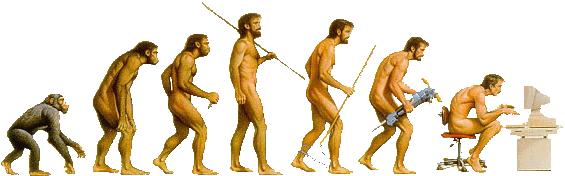
In today’s class we were asked to consider how the characteristics of our students might affect how they learn and what an ideal environment might look like for them.

Prensky (2001) wrote that “today’s students think and process information fundamentally differently from their predecessors,” that they are all Digital Natives – “native speakers of the digital language of computers, video games and the Internet.” By comparison, those of us who were not born into the digital world “are, and always will be compared to them, Digital Immigrants.”
As a ‘digital immigrant’ I remember what it was like turning o n my computer, waiting for the Internet to dial up (no Wi-Fi in the mid 90s!), logging on to the Sydney Morning Herald’s homepage, clicking on an image, leaving to make a cup of tea and returning to find my picture still loading! The (now antiquated but then new) technologies of the era instilled patience in their users. Just to type a simple letter using Wordperfect 5.1 for DOS required concentration and perseverance (Alt + F9 + 1 + 3 to insert an image).
By contrast, said Prensky, Digital Natives are used to receiving information really fast and like to parallel process and multi-task.
“Digital Immigrants typically have very little appreciation for these new skills that the Natives have acquired and perfected through years of interaction and practice. These skills are almost totally foreign to the Immigrants, who themselves learned – and so choose to teach – slowly, step-by-step, one thing at a time, individually, and above all, seriously.”
Prensky believes that this is the single biggest problem facing education today, “that our Digital Immigrant instructors, who speak an outdated language (that of the pre-digital age), are struggling to teach a population that speaks an entirely new language.”
So how can ‘digital immigrant’ instructors create ‘an ideal environment’ for their ‘digital native’ students?
The answer, I believe, can be found not in the tools (tactics) but in the approach (strategies). Whether lecturers use Prezi for their presentations, network with their students via LinkedIn, or organise field trips to Second Life, the approach they take must be authentic – because both digital natives and digital immigrants can spot a phony. Technologies used within university curriculums must be integrated and appropriate for the courses.
In 2005 the Faculty of Education at the University of Wollongong identified 10 elements for the design of authentic tasks in web-based learning environments:
Authentic tasks
• have real-world relevance
• are ill-defined, requiring students to define the tasks and sub-tasks needed to complete the activity
• comprise complex tasks to be investigated by students over a sustained period of time
• provide the opportunity for students to examine the task from different perspectives, using a variety of resources
• provide the opportunity to collaborate
• provide the opportunity to reflect
• can be integrated and applied across different subject areas and lead beyond domain-specific outcomes
• seamlessly integrated with assessment
• create polished products valuable in their own right rather than as preparation for something else
• allow competing solutions and diversity of outcome
One thought on “Digital natives debate”